If you reach the end of the working day feeling like you’re carrying a “bag of stones” on your shoulders, if you feel a burning sensation at the base of your neck, or if you get headaches that begin in the back of the head and work their way up to your eyes — this article is for you. The so-called “computer tension” is not just tiredness; it is a mechanical response from your body to hours of immobility. Let’s understand how to switch off that alarm signal.
The “Weight” of Your Head: Why Does It Hurt So Much?
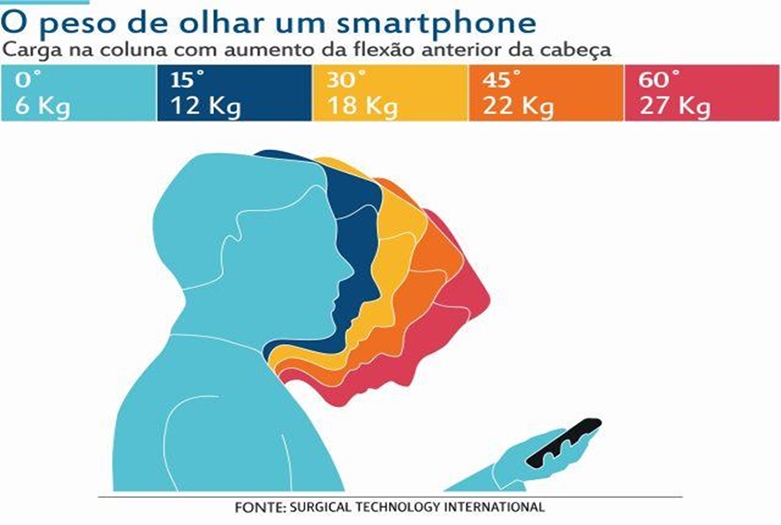
Imagine holding a bowling ball (your head, which weighs around 4–5 kg) close to your chest. Easy, right? Now imagine holding that same ball with your arm outstretched in front of you. The weight is the same, but the effort required to hold it is enormous.
When you are at the computer, focused on the screen, you tend to project your chin forward — known as forward head posture. This forces the muscles at the back of your neck and shoulders (the trapezius and levator scapulae) into constant contraction, hour after hour, to stop your head from “falling” forward. [4]
The result? Muscular ischaemia (insufficient oxygenated blood reaching the muscle), painful tension points, and that constant burning sensation. Studies show that forward head posture is associated with greater pain and cervical disability in adults. [4][5]
My Clinical View
Where the eyes go, the body follows
Neck and Shoulder Pain: Computer Tension
Do you feel a constant weight in your shoulders or a burning sensation in your neck by the end of the day? Here is why “sitting straight” is not enough.
Symptomatic Approach (Common)
The common mistake is trying to simply “massage where it hurts” or take muscle relaxants.
- Focus on local pain: Temporary relief only.
- Cause remains: The muscle becomes tense again hours later.
- Mechanical problem: The neck still has to support the head (the “bowling ball”) in the wrong position.
Functional Correction
We treat stiffness in the thoracic spine (mid-back) so the neck doesn’t have to work so hard.
- Focus on the base: When the mid-back is mobile, the top (neck) can relax.
- Postural correction: We realign the load of the head.
- Result: Lasting relief without dependence on medication.
The common mistake is trying to simply “massage where it hurts” or take muscle relaxants.
- Focus on local pain: Temporary relief only.
- Cause remains: The muscle becomes tense again hours later.
- Mechanical problem: The neck still has to support the head (the “bowling ball”) in the wrong position.
We treat stiffness in the thoracic spine (mid-back) so the neck doesn’t have to work so hard.
- Focus on the base: When the mid-back is mobile, the top (neck) can relax.
- Postural correction: We realign the load of the head.
- Result: Lasting relief without dependence on medication.
Symptoms and Red Flags
In addition to muscular pain, prolonged cervical tension can generate other symptoms that are alarming but perfectly explainable:
The domino effect
- Tension headaches: Pain that squeezes the head like a helmet, often originating in the suboccipital muscles (at the base of the skull) under compression.
- Arm tingling: Tension in the neck and shoulder girdle muscles can irritate or compress nerves descending into the arm.
- Morning stiffness: Waking up with a “locked” neck because the muscles could not relax during the night.
- The “hump”: Over time, the body builds denser, stiffer tissue at the base of the neck (zone C7–T1) in an attempt to protect the area from constant stress.
When it isn't just posture?
Although rare, seek urgent medical assessment if you experience:
- Intense dizziness when looking up or to the sides.
- Loss of strength in the hands (dropping objects).
- Electric shocks running down the spine when lowering your head.
How Manual Therapy Helps
Treatment is not about “putting bones back in place” — it is about restoring movement capacity and “resetting” muscle tone:
- Thoracic mobilisation: The neck is often the victim of mid-back stiffness. Mobilising the thoracic spine helps reduce mechanical load on the cervical region and improves posture without conscious effort. [2][3]
- Gentle cervical mobilisation: When correctly indicated, this helps reduce pain and improve range of motion, restoring joint lubrication. [1][2]
- Myofascial release: Targeted work on the trapezius, pectorals, scalenes and suboccipitals to relieve trigger points, reduce compression and improve tissue vascularisation.
- Breathing pattern correction: Teaching you to breathe without lifting your shoulders is essential so the trapezius can finally rest.
- Realistic ergonomics: I won’t ask you to sit like a robot. I will help you adapt your workstation and vary your posture intelligently throughout the day.
Recent evidence shows that a multimodal approach — combining manual therapy with exercise — delivers better outcomes than exercise alone for non-specific cervical pain. [1][2] International guidelines specifically recommend this combination of manual techniques, targeted exercises and education. [3]
Relieve the tension today
Assessment and treatment in Lisbon or Cascais
Book Your Session Nowor call +351 937 543 312
The Road to Recovery
Typical Results
- Reduction of the “heaviness” and burning sensation in the shoulders.
- Improved neck mobility (for example, being able to look behind you when driving).
- Decreased frequency and intensity of headaches.
- Reduction of the “heaviness” and burning sensation in the shoulders.
- Improved neck mobility (for example, being able to look behind you when driving).
- Decreased frequency and intensity of headaches.
- Greater body awareness: you notice when you are “hunching” your shoulders and correct it automatically.
- Better-aligned posture begins to require less conscious effort.
- You start tolerating longer working days without pain midway through.
- Greater body awareness: you notice when you are “hunching” your shoulders and correct it automatically.
- Better-aligned posture begins to require less conscious effort.
- You start tolerating longer working days without pain midway through.
- Ability to get through intensive working days without debilitating pain.
- Integration of active micro-breaks and quick exercises into the routine, without depending on frequent treatment.
- Ability to get through intensive working days without debilitating pain.
- Integration of active micro-breaks and quick exercises into the routine, without depending on frequent treatment.
Typical Results
- Reduction of the “heaviness” and burning sensation in the shoulders.
- Improved neck mobility (for example, being able to look behind you when driving).
- Decreased frequency and intensity of headaches.
- Reduction of the “heaviness” and burning sensation in the shoulders.
- Improved neck mobility (for example, being able to look behind you when driving).
- Decreased frequency and intensity of headaches.
- Greater body awareness: you notice when you are “hunching” your shoulders and correct it automatically.
- Better-aligned posture begins to require less conscious effort.
- You start tolerating longer working days without pain midway through.
- Greater body awareness: you notice when you are “hunching” your shoulders and correct it automatically.
- Better-aligned posture begins to require less conscious effort.
- You start tolerating longer working days without pain midway through.
- Ability to get through intensive working days without debilitating pain.
- Integration of active micro-breaks and quick exercises into the routine, without depending on frequent treatment.
- Ability to get through intensive working days without debilitating pain.
- Integration of active micro-breaks and quick exercises into the routine, without depending on frequent treatment.
* Results vary depending on severity, chronicity, and treatment adherence.
“SOS” Exercises for the Office
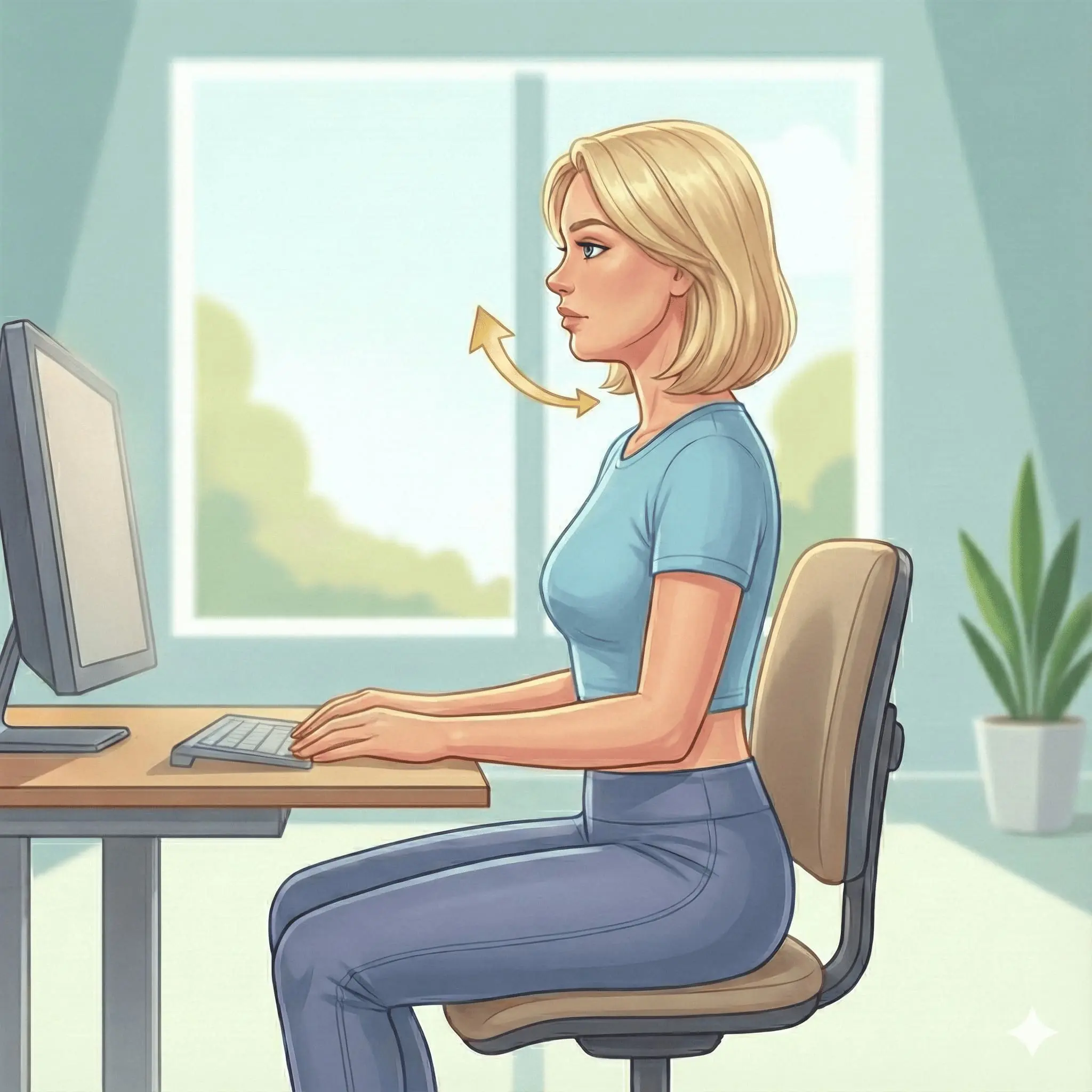
The Chin Tuck
10 x 5 seconds · Every 2 hoursThe Chin Tuck
Exercício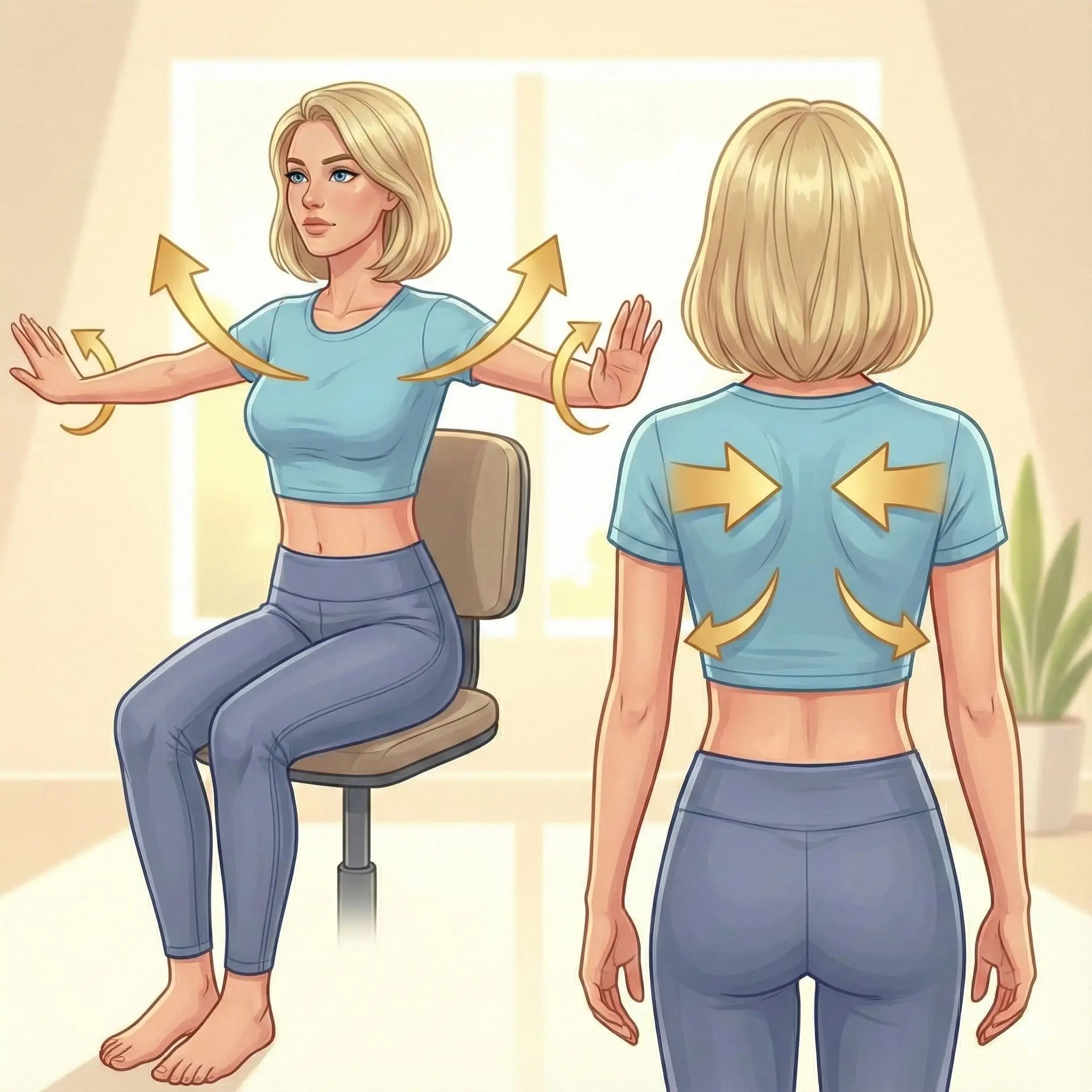
Thoracic Opening (Brugger)
2 x 30 seconds · Whenever you feel yourself slouchingThoracic Opening (Brugger)
Exercício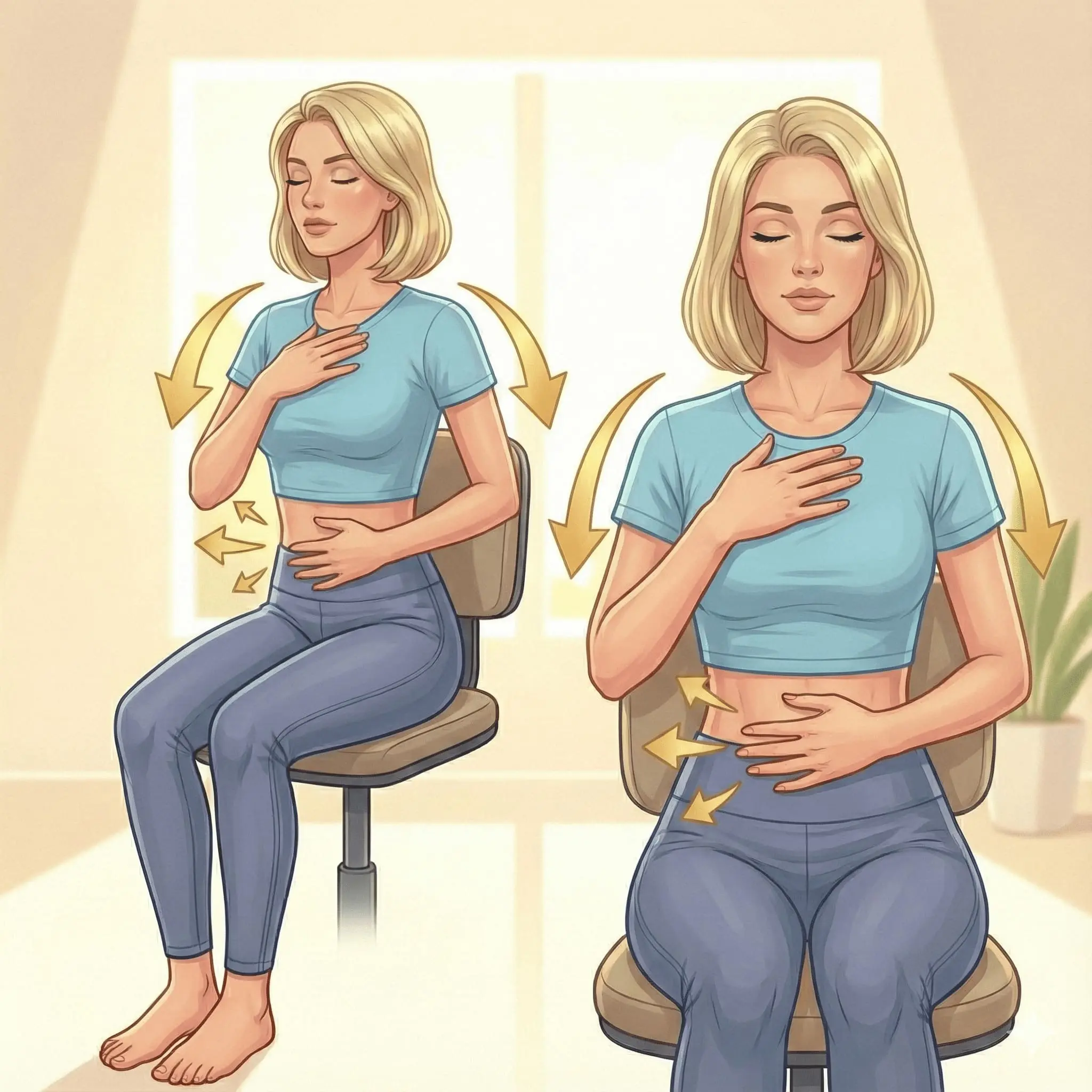
Diaphragmatic Breathing to Switch Off the Shoulders
5–10 breaths · 3–4 times per dayDiaphragmatic Breathing to Switch Off the Shoulders
ExercícioFrequently Asked Questions
Should I use a postural corrector (one of those elastic brace vests)? Generally not recommended as the main solution. These devices do the work for your muscles; when you remove them, the musculature is even weaker and posture tends to worsen. The goal is to train active control — not to depend on a “brace.”
At what height should my monitor be? Ideally, the top of the monitor should be at eye level or slightly below. If it is too low (such as a laptop directly on a desk), you will have to flex your neck and bring your head closer to the screen, increasing the load on the cervical spine. A laptop riser and an external keyboard can make a significant difference.
Is cracking your neck harmful? An occasional, spontaneous crack is not dangerous in itself. But if you feel a constant urge to crack your neck to relieve tension, this is a sign of imbalance between stiff segments and hypermobile segments. In that case, it makes more sense to treat the cause (stiffness, weakness, stress) rather than keep chasing more cracks.
Scientific Evidence
Scientific References
Pinto, M., et al. (2023). The combined effects of manual therapy and exercise on pain and disability in patients with nonspecific neck pain: a systematic review and meta-analysis. Medicina.
Hidalgo, B., et al. (2017). The efficacy of manual therapy and exercise for treating non-specific neck pain: a systematic review.
Scientific References
Pinto, M., et al. (2023). The combined effects of manual therapy and exercise on pain and disability in patients with nonspecific neck pain: a systematic review and meta-analysis. Medicina.
Hidalgo, B., et al. (2017). The efficacy of manual therapy and exercise for treating non-specific neck pain: a systematic review.