If shoulder pain keeps you awake at night, if you wake up in the middle of the night with a feeling of ‘aching’ or throbbing, or if you’ve had to stop sleeping on your preferred side, this guide is for you. Let’s simplify what’s going on with your shoulder and explain how the right treatment can give you back peaceful nights.
Why does your shoulder hurt more at night?
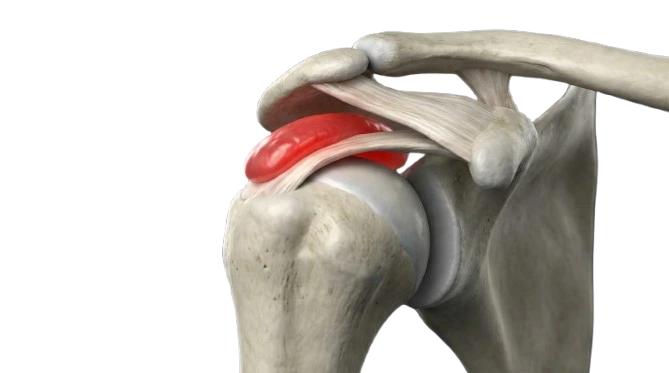
Many patients ask me: ‘Why can I move more or less normally during the day, but as soon as I lie down, the pain appears?’
The mechanical explanation is simple. During the day, gravity pulls the arm down, creating a small ‘clearance space’ within the shoulder joint. When we lie down, we lose this effect. The arm rises slightly and compresses the bursa and tendons (the famous ‘rotator cuff’) against the bone.
If there is already inflammation (bursitis or tendinitis), this extra compression when lying down is like stepping on a hose: the pressure increases, circulation decreases, and the pain shoots up. [1][4][6]
My Clinical Approach
Sleep is non-negotiable
---vs--- no meio do texto.What is causing this pain?
In addition to sleeping position, there are factors that turn mild discomfort into a sleepless night:
The main culprits
- Bursitis (inflamed “cushion”): We have a small fluid-filled sac (bursa) that protects the tendons. When inflamed, it hates direct pressure. That’s why lying on your shoulder is impossible. [1]
- Tired Tendons: Small tears in the rotator cuff tendons make them sensitive. If you sleep with your arm under the pillow (above your head), you are twisting those tendons all night long. [4][6]
- Stiff Back: If your thoracic spine (the area of the shoulder blades) is too stiff, your shoulder has nowhere to rest and ends up supporting the entire weight of your torso. [2][3]
Warning Signs
Manual therapy resolves the vast majority of these cases, but you should consult a doctor if:
- The pain is excruciating even when you do not move (complete rest).
- You have a fever or your shoulder is hot and red.
- You have a sudden loss of strength (unable to lift your arm at all).
How Manual Therapy Solves the Problem
Our goal at the clinic is simple: To give the tendon room to breathe.
- Create Joint Space: We use gentle manual techniques to mobilise the shoulder, relieving pressure on the bursa and tendons. Relief is usually immediate. [1][2]
- Release the ‘Armour’: We relax the chest, neck, and back muscles that, due to pain, are contracted and pulling the shoulder into an incorrect position. [2][3]
- Sleep Hygiene: We teach you exactly how to use pillows to position your arm in a neutral position, allowing you to sleep without pain while the injury heals.
- Strengthen without Hurting: We introduce specific exercises that activate the muscles without aggravating the inflamed area. [2][3]
Current scientific evidence recommends that subacromial pain be treated, in most cases, with physiotherapy and exercise, avoiding unnecessary surgery. [1][5]
I want to sleep well again
Book your assessment in Lisbon or Cascais
or call +351 937 543 312
What to Expect from Treatment
Typical Results
- Fewer night-time awakenings.
- Learn to find a comfortable position in bed.
- Your shoulder feels ’lighter’ in the morning.
- Fewer night-time awakenings.
- Learn to find a comfortable position in bed.
- Your shoulder feels ’lighter’ in the morning.
- You can now sleep on your side for longer periods.
- You can perform everyday movements (putting on a coat, combing your hair) without pain.
- You can now sleep on your side for longer periods.
- You can perform everyday movements (putting on a coat, combing your hair) without pain.
- Continuous, restful sleep.
- Your shoulder is strong enough to prevent the pain from returning.
- Continuous, restful sleep.
- Your shoulder is strong enough to prevent the pain from returning.
Typical Results
- Fewer night-time awakenings.
- Learn to find a comfortable position in bed.
- Your shoulder feels ’lighter’ in the morning.
- Fewer night-time awakenings.
- Learn to find a comfortable position in bed.
- Your shoulder feels ’lighter’ in the morning.
- You can now sleep on your side for longer periods.
- You can perform everyday movements (putting on a coat, combing your hair) without pain.
- You can now sleep on your side for longer periods.
- You can perform everyday movements (putting on a coat, combing your hair) without pain.
- Continuous, restful sleep.
- Your shoulder is strong enough to prevent the pain from returning.
- Continuous, restful sleep.
- Your shoulder is strong enough to prevent the pain from returning.
* Results vary depending on severity, chronicity, and treatment adherence.
Practical Tips for Tonight
The Pillow Hug
When sleeping · Whenever necessaryThe Pillow Hug
ExercícioOpen Book
10 gentle repetitions · Before bedtimeOpen Book
ExercícioFrequently Asked Questions
Why does it hurt so much at night? It is a combination of inflammation and lack of movement. During the day, movement ‘pumps’ fluids. At night, static compression and lack of gravity build up pressure in the inflamed area.
Do medications work? They help to temporarily ‘silence’ the pain, but they do not resolve the mechanical conflict (the lack of space in the shoulder). Manual therapy and exercise resolve the cause.
How long does it take to get better? It depends on each person, but with the right treatment, most patients experience significant relief in sleep quality within the first 2 to 4 weeks.
Scientific References
Scientific References
Diercks, R. L., et al. (2014). Guideline for diagnosis and treatment of subacromial pain syndrome. Acta Orthopaedica.
Hanratty, C. E., et al. (2017). Effectiveness of conservative interventions including exercise and manual therapy. British Journal of Sports Medicine.
Scientific References
Diercks, R. L., et al. (2014). Guideline for diagnosis and treatment of subacromial pain syndrome. Acta Orthopaedica.
Hanratty, C. E., et al. (2017). Effectiveness of conservative interventions including exercise and manual therapy. British Journal of Sports Medicine.